travel · 3 min read
The Cultural Triangle: Anuradhapura, Polonnaruwa and Sigiriya
Two ruined capitals, a rock fortress and a cave temple, all within a few hours of each other in the dry zone. Here's what each one is and how to see them without burning out.
· Sigiriya
The Cultural Triangle is the shorthand for the cluster of ancient sites in Sri Lanka's north-central dry zone. Four places carry it: Anuradhapura, Polonnaruwa, Sigiriya and Dambulla. They are close enough to combine and different enough that doing all four does not feel repetitive.
Anuradhapura — the thousand-year capital
The oldest and the largest, and the one that rewards patience. This was the island's capital for over a millennium, and the site is a spread-out sacred city rather than a compact ruin — you need a bicycle, a tuk-tuk or a car to move between the parts.
What to see:
- Ruwanwelisaya, a vast white stupa, still one of the most important pilgrimage sites in the Buddhist world
- Sri Maha Bodhi, the sacred fig grown from a cutting of the Buddha's own tree
- Jetavanaramaya and Abhayagiri, enormous brick stupas that were among the tallest structures in the ancient world
- Isurumuniya, a small rock temple with the famous "lovers" carving
This is a living religious site, not just an archaeological one. White clothing is normal, shoes come off at the sacred areas, and you will be walking on hot sand — bring socks.
Polonnaruwa — the compact one
The capital after Anuradhapura, at its height in the 12th century under Parakramabahu I. Everything is closer together, so it is the easier of the two to see in a morning, ideally by bicycle.
The highlight is Gal Vihara: four colossal Buddha figures cut from a single granite face, including a standing figure and a reclining one. The carving is extraordinary — you can see the grain of the stone used deliberately in the drapery.
Also worth your time: the Quadrangle, a tight cluster of shrines including the circular Vatadage, and the Parakrama Samudra, the reservoir that made the city possible.
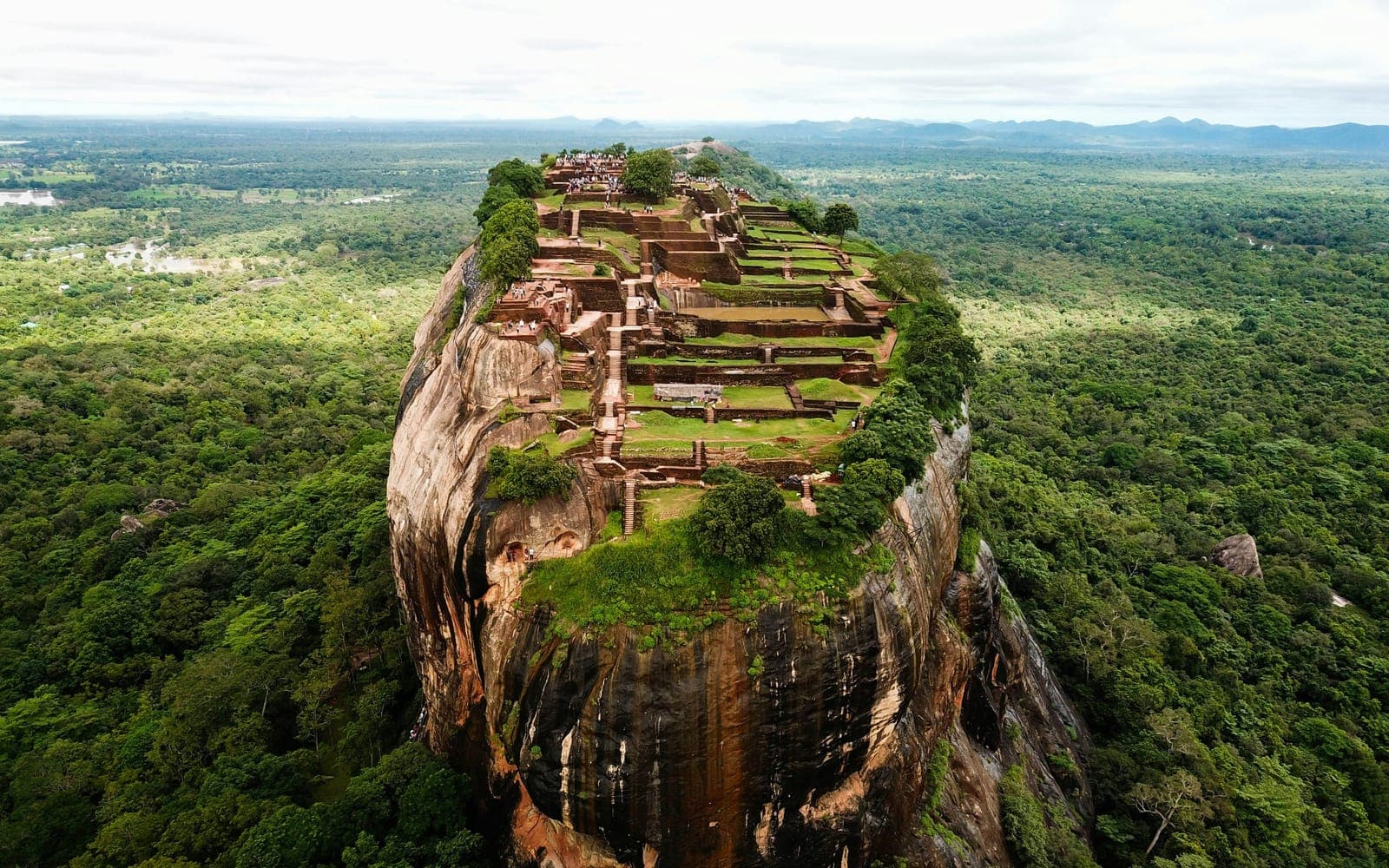
Sigiriya — the rock
A 5th-century citadel on top of a granite monolith rising abruptly out of the plain. King Kashyapa built it, reputedly after seizing the throne from his father, and it was abandoned as a capital within a few decades of his death.
The climb takes you past a mirror-polished wall covered in graffiti left by visitors over a thousand years ago — genuine ancient tourist comments, many of them about the frescoes of court women painted in a sheltered pocket of the rock face. Near the top, the staircase passes between two enormous carved lion's paws, all that remains of a gateway that was once a whole lion.
Go at opening time. It is a real climb on exposed steps and the plain gets brutally hot by mid-morning.
Dambulla — the cave temple
Five caves under an overhanging rock, filled with more than a hundred Buddha statues and covered — walls and ceiling — in murals that follow the contours of the rock. The complex has been added to over roughly two thousand years, so you are looking at layers of different centuries in one room.
It is the shortest visit of the four and, for many people, the most atmospheric.
Doing it sensibly
- Base yourself in one place. Sigiriya or Dambulla town puts everything within reach.
- Three days is comfortable for all four. Two is possible; one is a mistake.
- Mornings and late afternoons. The dry zone is genuinely hot and there is very little shade at the ruins.
- Dress for temples: shoulders and knees covered, shoes off at shrines. Never pose with your back to a Buddha image — it causes real offence and has got visitors into serious trouble.