travel · 3 min read
Kandy and the Temple of the Tooth
The last kingdom to fall, a relic that conferred the right to rule, and the biggest procession in the Buddhist world. Kandy is where Sri Lanka's living tradition is most visible.
· Kandy
Kandy sits in a bowl of hills around an artificial lake, and it holds a particular place in the national imagination: it was the last independent kingdom on the island, holding out in the interior for two and a half centuries after the coast had fallen to Europeans. It only came under British control in 1815.
The Temple of the Tooth
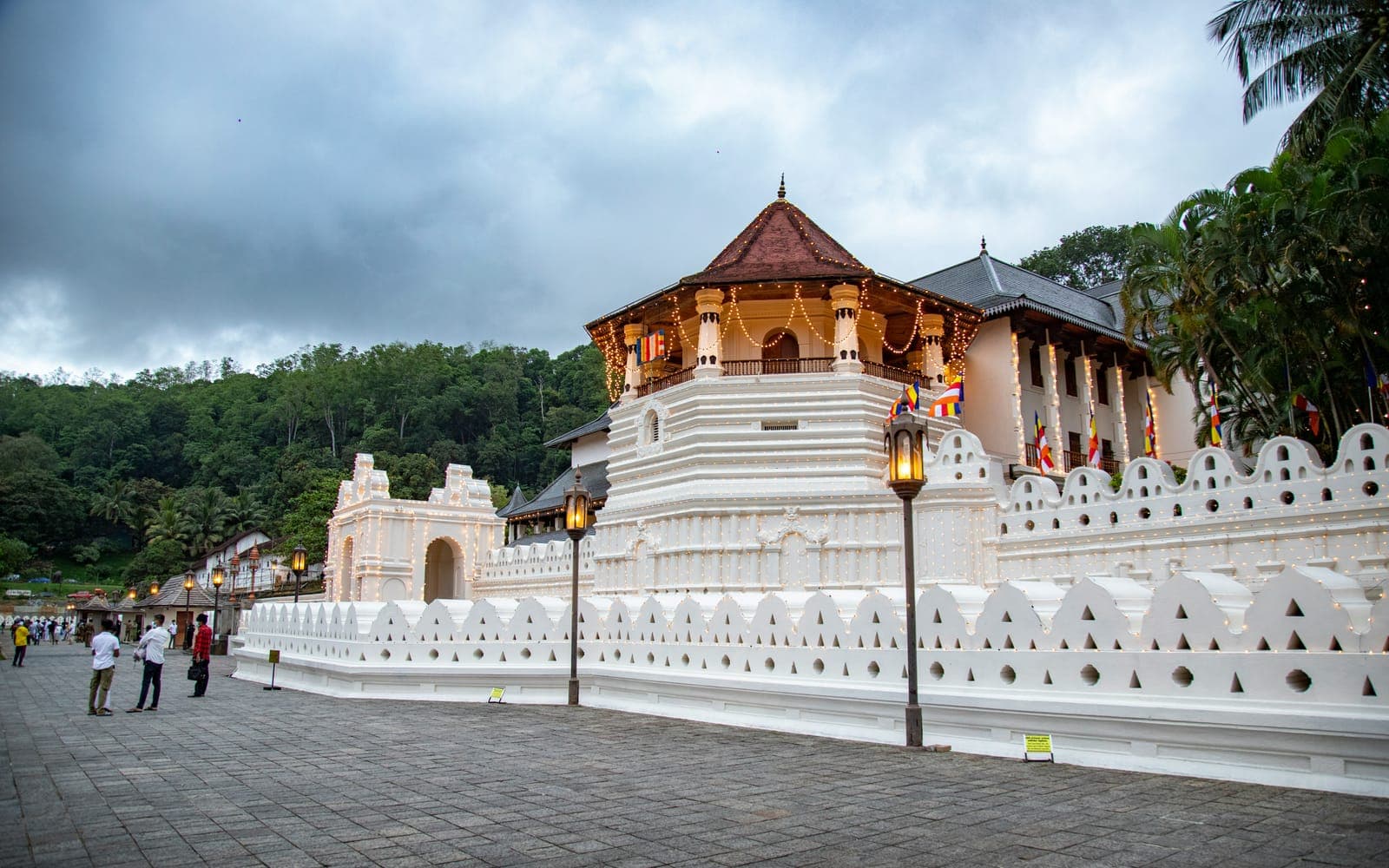
Sri Dalada Maligawa — the Temple of the Sacred Tooth Relic — houses a tooth said to be the Buddha's, brought to the island in about the 4th century CE.
The relic is not merely a holy object. For most of Sri Lankan history, whoever held the tooth held the right to rule, which is why it moved with the capital from Anuradhapura to Polonnaruwa and eventually to Kandy, and why control of it was fought over so persistently.
You do not see the tooth. It sits within a series of nested golden caskets in an inner chamber, and what visitors see is the shrine, the caskets' housing, and the ritual around them. Three times a day there is a pooja, announced by drummers and horn players, when the inner chamber's doors are opened for offerings. Go for one of these — the drumming in the enclosed upper hall is the experience.
Practicalities: white or modest clothing, shoulders and knees covered, shoes and hats off. Security is thorough. The complex is busiest and most atmospheric in the early evening.
The Esala Perahera
For ten nights in July or August — the date follows the lunar calendar — Kandy stages the Esala Perahera, and it is one of the great religious processions anywhere.
Tusker elephants in embroidered caparisons, whip-crackers clearing the route, fire dancers, Kandyan drummers, and troupes of dancers move through the streets each night, the procession growing longer as the nights go on. The final night carries a replica of the tooth relic's casket on the lead elephant.
If you want to see it, book accommodation months out. The whole city fills.
Kandyan dance and drumming
Kandyan dance is a distinct classical tradition with its own vocabulary, costume and drum — the double-headed geta bera. It is genuinely athletic, and it descends from ritual rather than entertainment. There are nightly cultural shows in Kandy that compress several forms into an hour; they are touristy but the technique on display is real.
The rest of the city
- The Royal Botanic Gardens at Peradeniya, just outside town, are among the finest in Asia — worth half a day, especially the palm avenues and the giant Javan fig.
- The lake was built by the last king of Kandy; the walk around it takes about an hour.
- The market in the centre is a working municipal market and a good place to see the spice trade at street level.
- Kandy is the junction for the hill-country train to Nuwara Eliya and Ella, which is the single most enjoyable stretch of railway in the country.
A note on the elephants
Elephants in the Perahera and at temples are captive animals, and standards of care vary considerably. Riding elephants is widely offered and is not recommended — the training involved is harsh, and there are better ways to see them. Wild elephants at Udawalawe or Minneriya, seen from a vehicle at a distance, are the honest alternative.